
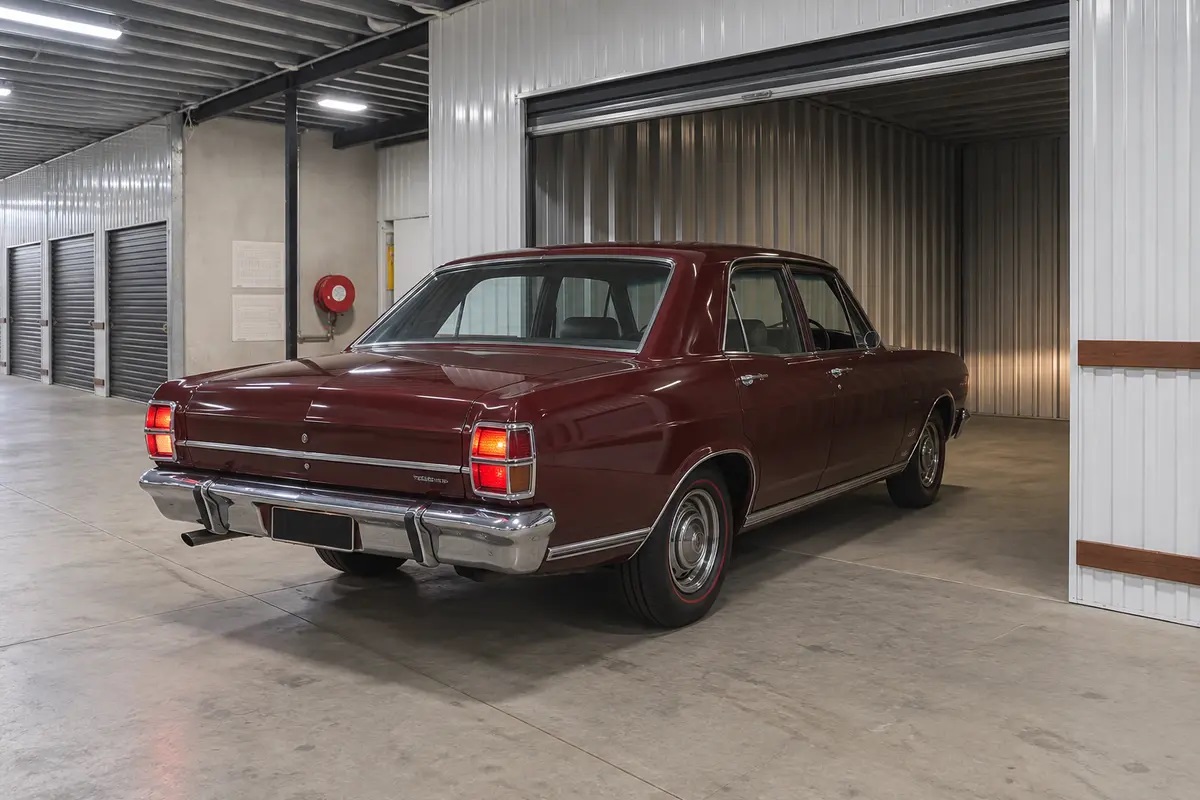
What Changes When Your Beloved Classic Car Isn’t a Daily Driver
Most storage advice is written for a car that gets driven. Fill the tank, check the tyre pressures, throw a cover over it, come back in six months. That’s fine for a three-year-old hatchback going away while its owner works overseas.
It’s less useful if what you’re putting away has chrome, a club permit and a fuel system that predates unleaded.
I’ve run a storage facility for more than twenty years and the enthusiast cars are always the ones where the owner has thought hardest about the car and least about the arrangement around it. The mechanical preparation tends to be excellent. The registration, the insurance and the question of what the car actually needs from the place it’s sitting in are the parts that get sorted out afterwards, usually in a hurry.
So, this isn’t another preparation checklist. It’s actually the decisions that come before that.
Where the car lives is a registration question before it’s a storage question
Club permit and historic registration schemes exist in every state and the conditions attached to them are not identical. Some of those conditions touch on how the vehicle is used and where it’s kept.
If your car is on one of these schemes, read the conditions before you move it or ring the club that signs your paperwork. They deal with this constantly and they’ll tell you in two minutes whether a change of storage location matters for your particular permit. It’s a much better conversation to have in advance than to discover a problem at renewal.
Full registration is simpler, but it’s still worth a thought. A car sitting for a year on full registration is money going out for nothing and depending on what you’re planning, a permit scheme or putting the registration on hold might suit you better.
Tell your insurer before you move it, not after
Agreed value policies are generally written against a stated garaging address. That address is part of what the insurer priced the policy on.
Moving the car to a storage facility changes where it’s kept. Whether that helps your premium, hurts it, or makes no difference at all depends entirely on the insurer and the policy and I’m not going to guess on their behalf. What I will say is that the phone call takes five minutes and it’s the sort of detail that becomes very expensive if it only surfaces at claim time.
Ask them specifically about the storage address, about who has access to the building and about whether anything changes if the car isn’t being driven at all during the period.
The things that age, rather than the things that break
A modern car left alone for six months is mostly fine. The battery goes flat and the tyres want checking. That’s the bulk of it.
An older, classic car is a different proposition because the parts that struggle with time aren’t the mechanical ones. Rubber is the big one. Seals, hoses, window rubbers and bushes all harden and perish with age regardless of kilometres and a long layup doesn’t help them. Interior trim and chrome are similarly patient until suddenly they aren’t.
Fuel is the other one. Older fuel systems weren’t designed around the ethanol blends that are common at the pump now and a lot of owners will either seek out an ethanol-free fuel or use a stabiliser before a long layup. Plenty of clubs have a settled view on this for particular makes and that’s usually better guidance than anything general I can offer.
None of this is a reason not to store a car. It’s a reason to store it somewhere dry and undercover and to go in with your eyes open about what a twelve month storage period asks of a fifty year old car.
Starting it every month: the argument both ways
This one gets argued about at every car show in the country and it’s one of the most common questions we get asked as owners and managers of a storage facility. Here are both positions…..honestly.
The case for starting it: running the engine circulates oil, keeps seals wet, puts some charge back into the battery and gives you a regular reason to lay eyes on the car.
The case against: a ten-minute idle doesn’t get the engine anywhere near operating temperature. It doesn’t burn off the moisture that combustion produces so that condensation ends up sitting in the oil and the exhaust. On that reading, a monthly idle is arguably worse than leaving it alone.
Where most experienced owners land is somewhere in the middle. If you can actually drive the car properly for long enough to get it up to temperature, do that. If you can’t, prepare it properly for a genuine layup and leave it alone with a battery maintainer doing its job and a visit every few weeks to check the car rather than to run it.
That’s the argument for storing somewhere you can get to easily. A storage facility you can reach on a weekend morning with room to open the doors and look the car over properly, is worth more than a cheaper one you never visit. If you’re weighing up long term car storage, access hours matter more than most people expect going in.
The shed at home versus a facility
Plenty of enthusiasts have a garage and the honest answer is that a good home shed is hard to beat. It’s free, you’re there and you can potter around the car whenever you feel like it.
The trade-offs are the ones you already know. The shed competes with everything else the household needs to put somewhere. Security is whatever your house has. If the car is genuinely valuable, a lot of owners reach a point where they’d rather it wasn’t sitting behind a single roller door on a suburban street.
What a facility adds is fairly specific: undercover space that isn’t shared with the family car, monitoring and someone whose job it is to look after your pride and joy 24/7. What it costs you is convenience and a monthly fee. Which side of that you land on depends on the car and on how much shed you’ve got.
The one thing I’d say is to go and look before you book. Measure the door, check the approach and work out whether you can actually get the car in and out without a three point turn. Photos on a website will not tell you that.
About the author
Rick Mooibroek runs Aussie Safe Storage, a family-owned self-storage facility in Pakenham, Victoria. He has more than twenty years in the industry, has stored countless classic vehicles and lives on site, which means there is always someone on the property, not just a camera and a call centre. The facility has undercover drive-through units up to 6 metres by 3 metres, perfect for long-term car storage.